

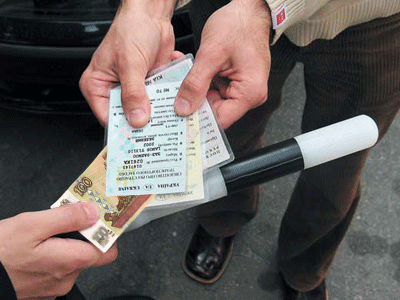
The "price list" of road police bribes is an archive review of the results of an online survey published in 2013. The material shows public perception of corruption in that period, but does not reflect current fines, practice or the real cost of unlawful acts.
What the 2013 survey was about
The online sociological survey of the Anti-Corruption Committee under the public association "Kazpotrebnadzor" collected respondents' reports of the supposed amounts of unlawful payments for traffic offences. These were the answers of survey participants, not official statistics of law enforcement bodies.
The results cannot be used to assess the current situation. Over the years, fines, rules, the structure of the authorities, digital recording of violations and payment methods have changed. In addition, an online survey does not guarantee representativeness or verification of every report.
Archive results
According to the publication, the highest average unlawful payment named by respondents was for driving under the influence of alcohol or drugs — 82,638 tenge. The stated range was from 5,000 to 500,000 tenge.
The old regional comparison named Astana, the Mangystau region and Almaty. These figures relate solely to that survey and do not allow any conclusion about the current level of corruption in a region.
Second place was driving without a driver's licence on one's person — 8,078 tenge, and third — driving by a person who has no right to drive, 7,292 tenge. Driving into the oncoming lane was valued by participants at 6,706 tenge.
The 2013 survey table
| Rank | Type of offence in the original publication | Average amount, tenge |
|---|---|---|
| 1 | Driving under the influence of alcohol or drugs | 82,638 |
| 2 | No driver's licence on one's person | 8,078 |
| 3 | Driving by a person who has no right to drive | 7,292 |
| 4 | Driving into the oncoming lane | 6,706 |
| 5 | Failure to comply with an officer's order to stop | 4,809 |
| 6 | Evading compulsory insurance | 4,492 |
| 7 | Running a red traffic light | 3,647 |
| 8 | Speeding | 3,474 |
| 9 | Failure to give way to pedestrians or other road users | 3,300 |
| 10 | Failure to comply with signs or road markings | 2,702 |
| 11 | Violation of stopping or parking rules | 2,549 |
| 12 | Driving without a technical inspection | 2,530 |
| 13 | Using a phone or radio while driving | 2,408 |
All the amounts in the table are reprinted from the archive material and are not tariffs, recommendations or current statistics.
Why these data should be treated critically
- an online survey does not confirm the circumstances of each report;
- the exact size and structure of the sample are unknown;
- answers may have reflected rumours and subjective experience;
- the amounts do not take account of inflation and changes in legislation;
- regional comparisons without a sufficient sample may be erroneous;
- data from 2013 cannot be carried over to today's police.
The original claim that officers of principle supposedly formed a minority is not supported by reliable statistics and has been removed. An indefinite group of people cannot be accused on the basis of an anonymous survey.
What to do when your car is stopped
- Stay calm and comply with the officer's lawful requests.
- Ask the reason for the stop and which offence is alleged.
- Ask for the documents to be drawn up officially. Do not offer cash or a transfer.
- Check the document before signing and state your disagreement, if you have any.
- Pay the fine only by an official method and keep the confirmation.
- Appeal the decision in the prescribed manner if you consider it unlawful.
If a bribe is demanded
Do not bargain and do not provoke unlawful acts. Remember the time, place, position, name, car number and other circumstances. Keep lawfully obtained documents, messages, audio or video, and do not edit the originals.
You can report an instance of corruption:
- to the free call centre of the Anti-Corruption Service at 1424;
- through the official eOtinish service;
- through the official channels of the Anti-Corruption Service;
- to the police at 102, if an immediate response is needed.
For the Antikor 1424 WhatsApp chatbot, government resources give the number +7 777 000 14 24. Before sending a message, check that the contact is current on gov.kz.
Confidentiality and protection of the person reporting
Government sources state that reports are considered confidentially, and a person who has reported a corruption offence and assists in combating corruption is under state protection within the limits of the law.
A report must be made in good faith. A knowingly false statement may entail liability. Pass on facts and evidence, separating them from assumptions.
Why official processing is more advantageous
Right to appeal
An official document can be challenged; an unlawful payment creates no legal protection.
Proof of payment
A receipt records performance of the obligation and rules out a repeat demand.
Safety
Refusing to pay a bribe reduces the risk of criminal and other liability for the driver.
Compulsory motor insurance
The archive table mentioned evading compulsory insurance. A compulsory MTPL policy for vehicle owners should be arranged only with a licensed insurance company. An agent or a website may help with arranging it, but the insurer is the organization named in the policy.
Check that the policy is valid and pay for it by an official method. Do not hand money to a police officer to "settle" the absence of insurance.
This material is not legal advice. Check fines, procedures and contacts on official government resources.