

- GVFMC and OSMS
- Who participates
- Rates in 2026
- Which services are available
- How to check your status
- For employers
- Frequently asked questions
How OSMS differs from guaranteed care
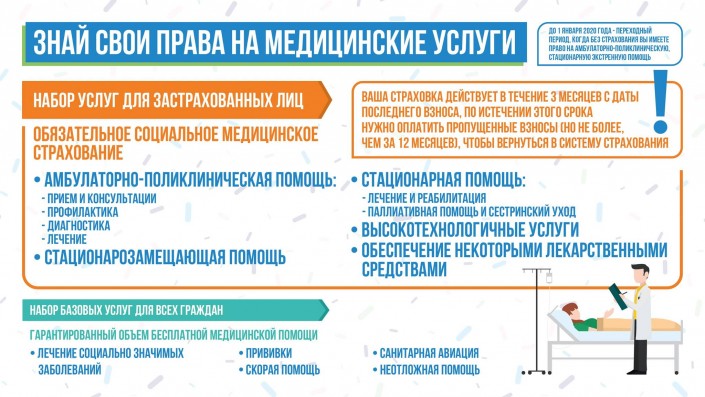
The guaranteed volume of free medical care (GVFMC) is provided in cases established by the state, regardless of insured status. It covers care for emergency conditions, socially significant diseases and other services provided for by the state.
The OSMS package is available to persons with "insured" status. It expands access to planned diagnostics, specialist consultations, treatment and rehabilitation within the rules of the system. A specific service is provided where there are medical indications and, where required, a referral.
Who participates in the system
The way a person participates depends on their employment and social status. For an employee, payments are made by the employer: contributions at the employer's expense and deductions from the employee's income. Individual entrepreneurs and self-payers pay the prescribed contributions themselves.
- employees — payments are calculated and remitted by the employer;
- individual entrepreneurs and persons in private practice pay for themselves;
- self-payers remit contributions in the prescribed amount;
- the state pays for the preferential categories provided by law;
- a special procedure applies under certain special tax regimes.
The categories for which the state pays include, in particular, children and other persons listed in the law. The list and conditions should be checked against the current version of the legislation, as social status may change.
OSMS payment rates in 2026
| Category | Rate | Features in 2026 |
|---|---|---|
| Employer | 3% of the employee's eligible income | The upper limit of the base is 40 minimum wages; the maximum contribution is 102,000 tenge per month |
| Employee and individual under a civil-law contract | 2% of income | The upper limit of the base is 20 minimum wages; the maximum contribution is 34,000 tenge per month |
| Individual entrepreneur, head of a peasant farm, person in private practice | 5% of 1.4 minimum wages | 5,950 tenge per month at the 2026 minimum wage |
| Self-payer | 5% of 1 minimum wage | 4,250 tenge per month at the 2026 minimum wage |
| Special regime for the self-employed | 1% of the taxable base | Applied in accordance with the Tax Code and the chosen regime |
The data are given as of 2026. Rates and monetary amounts should be rechecked whenever the minimum wage or legislation changes. The official basis is the Law of the Republic of Kazakhstan "On Mandatory Social Health Insurance" and the clarifications of state bodies.
An employer remits two different payments: its own contributions of 3% and the deductions of 2% withheld from the employee's income. These amounts cannot be combined into a single rate for the employee.
Which services may be provided under OSMS
- consultations with specialists on referral;
- diagnostic tests and laboratory analyses;
- planned inpatient and day-care care;
- medical rehabilitation;
- certain types of high-technology medical care;
- medication provision in the cases provided;
- other services included in the OSMS package.
Having "insured" status does not mean that any examination will automatically be prescribed at the patient's request. The decision is made by the medical professional, taking into account indications, clinical protocols and the patient pathway.
Where to go for medical care
The first point of contact is usually the polyclinic to which the patient is registered. A primary healthcare doctor assesses the patient's condition, prescribes the available tests and, if necessary, issues a referral to a specialist or a hospital.
How to check your insured status
- Check your status through the official electronic service or app.
- If there is no status, find out for which months payments are missing.
- Employees should compare the information with their payslips and contact their employer.
- Self-payers need to check the payment purpose code and the period.
- After the correction, wait for the information to update and check again.
To regain the right to care in the system when there are arrears, the law provides for paying contributions for the unpaid period, but not more than twelve months preceding the payment date, in the prescribed amount. Before paying, it is better to check the exact period and your payer category.
What matters for employers
- correctly determine the base and the upper limit for each payment;
- calculate the employer's contributions and the employee's deductions separately;
- meet the remittance deadlines;
- check the IIN and the payment period;
- take into account the exemptions for categories provided by law;
- inform employees about the amounts withheld and remitted;
- correct errors in payment documents without undue delay.
If an employee belongs to a category for which the state pays, the employer should check the rules on exemption from the corresponding payments. The grounds must be supported by up-to-date data and documents.
Frequently asked questions
Can I receive emergency care without OSMS status?
Emergency care and guaranteed-volume services are provided under the rules established by the state. The absence of status should not be a reason to delay seeking help when life or health is at risk.
Who pays for an employee?
The employer pays its contributions at its own expense and remits the deductions withheld from the employee's income. In 2026, rates of 3% and 2% respectively apply, subject to the base limits.
What should I do if a service is refused?
Ask for the reason in writing, contact the patient support service of the medical organisation and, if necessary, the Social Health Insurance Fund or the authorised body. For the assessment, it is important to know your status, whether you have a referral and the medical indications.
Does OSMS replace voluntary medical insurance?
No. OSMS provides a state package under established rules. A voluntary plan may include service levels, clinics and services under a separate contract, but it does not cancel the mandatory payments.
Official sources
- Law of the Republic of Kazakhstan "On Mandatory Social Health Insurance";
- official questions and answers on OSMS payments in 2026.
Conclusion
OSMS in Kazakhstan is based on regular payments and on tracking the participant's status. In 2026, the main percentage rates remain the same, but the upper income limits used to calculate payments for employees and employers have been changed. Before paying, check your category and the current rules.
This material was updated as of 2026 and is for information purposes only. Legislation and calculation indicators may change; check official sources before making a payment.